
A practical way to choose wholesale skincare sets: give every set a clear job in your range, verify that each kit’s contents and sizes work at your retail price, and plan opening quantities so fast-moving components can be replenished as single items. Three decisions drive the result — set roles, kit contents, and opening order size — and margin must be calculated on the kit’s total price, not on the value of its parts. Because kits sell as one unit, a range staff can explain easily moves faster than a long catalogue of overlapping sets.
Build A Set Role Map For Your Retail Range
Skincare sets are not one category; they are several. Entry-level starter sets with three or four steps fit beauty chains and independent stores where customers buy their first routine. Full routines — cleanser, toner, serum, day cream, night cream — fit pharmacies and higher-service retail where staff can walk a customer through each step. Travel and gift formats suit convenience channels, airport retail, and seasonal gifting windows. The same set can underperform in one channel and sell well in another, so record the concern, channel, and price band for every planned set.
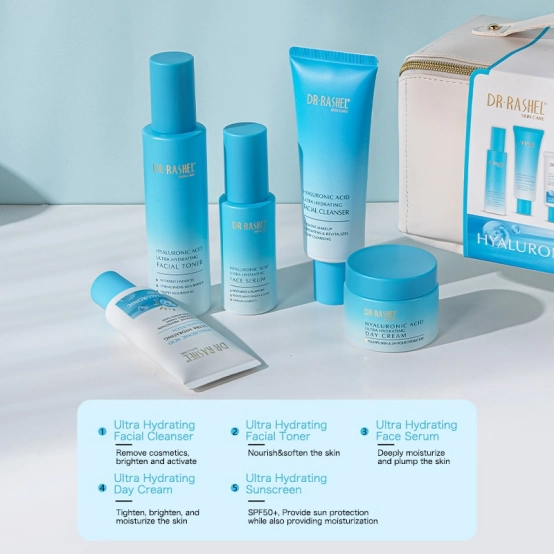
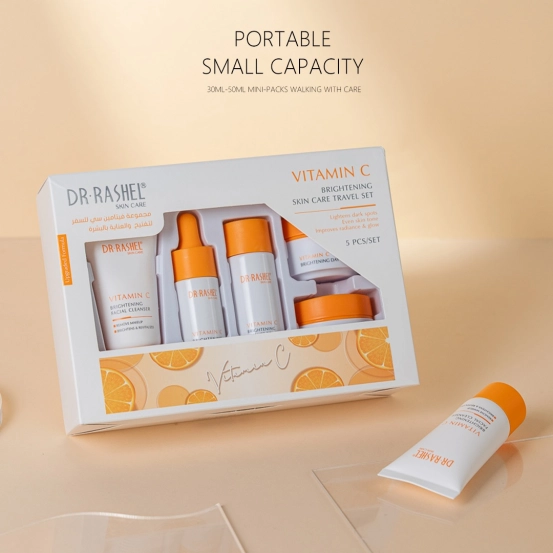
Decide next whether you will buy complete kits or assemble sets from individual SKUs. Pre-made kits keep SKU counts and replenishment lines low. Kits built from components give you more control over assortment, mix, and price. Dr. Rashel’s facial care sets range shows both patterns, from complete routines such as the Kit de cuidados para a pele com ácido hialurônico e ultra-hidratante to compact travel and gift formats. Choose the sourcing pattern your warehouse and ordering process can manage in every reorder cycle, not just at launch.
Evaluate Kit Contents Before You Evaluate Price
Two questions decide whether a kit will sell: is the routine complete, and do the component sizes justify the retail price?
- Routine completeness.The set should cover a clear sequence, and the active step — usually the serum — should stand out. If two components do the same job, ask whether a simpler kit exists.
- Component sizes.Sample sizes keep travel sets affordable, but a shelf kit that looks like a sample range will struggle to hold its price. Request the component list with individual volumes for each SKU.
- Claim support.The actives a customer expects from the label should be reflected in the product documentation you can request for the destination market, rather than assumed from the set name.
- Packaging as a retail unit.On the sample, check closures, seals, readable labels, and internal supports, and record outer dimensions and packed weight. Confirm how component batch and expiry details are recorded.
A routine that lists each step separately — cleanser, toner, serum, day and night cream — is easy to merchandise because the set tells its own story on a shelf card.
Calculate Kit Margin With A Worked Example
Kits are priced as a unit, so the margin question is what share of the kit’s retail price remains after landed cost. Use the basic formula:
Gross margin (%) = (net selling price − landed cost per set) ÷ net selling price × 100
Worked example (illustrative figures, not a supplier quote):
- Five-piece set: wholesale $17.00 per kit
- Target margin: 40% of retail price
- Retail price: $17.00 ÷ (1 − 0.40) ≈ $28.30, rounded to $28.90
- Cost share of retail: 17 ÷ 28.90 ≈ 58.8%
- Value per component at retail: $28.90 ÷ 5 ≈ $5.78
Gross margin is not net profit: marketplace fees, advertising, fulfillment, and returns still need to be deducted, and a promotion that cuts the selling price to $17 drops the margin to roughly 29.4%. Check the kit against the single items on your shelf. If the customer can buy the same serum for $9.90 and the other four steps feel thin, the kit loses. Finally, confirm what the quoted unit price includes — packaging, carton configuration, and freight terms — because those items move the landed cost and the calculation with them.
Plan Opening Quantities And Single-Item Replenishment
The opening order should be small enough that a fast seller can be restocked before the next carton of complete kits arrives. A workable structure: launch two to four set SKUs, track sell-through per kit and per component, and — if the serum inside a kit sells out while full kits remain — reorder that serum as a single SKU instead of waiting for the next shipment of complete sets.
- Order by sell-through, not by carton convenience.If the only purchase option is a carton of 100 kits and your test volume is 40 units, choose a different format instead of forcing the carton.
- Reorder singles for proven fast movers.Once a component’s demand is proven in your store, replenish it individually and keep the kit for customers who buy the routine.
- Do not inflate the first order to reach a minimum.A conservative opening order costs less than dead inventory tied up in purchasing cash.
The goal is a range where every kit has a defined role, every fast-moving component has a replenishment path, and every price can be defended on the shelf.
Perguntas frequentes
How Do I Decide Between Complete Kits And Building Sets From Single Items?
Complete kits are simpler to order, with fewer SKUs and one replenishment line per set. Building from individual SKUs gives more control over mix and price, but each component is carried separately. Choose the pattern you can run in every reorder cycle, and confirm the supplier can sell both the kit and its components if you need to switch.
What Opening Order Size Should A New Retail Range Use?
Size the order to your restock speed, not to a minimum. Fifty to 200 units per set is a common start for a single store or small distributor and keeps a wrong choice affordable. Step up only if your channel moves volume quickly; keep a path to reorder fast movers individually.
Should Kit Pricing Reflect The Sum Of The Individual Products?
No. Customers compare the kit’s price against the value of the routine, and you should calculate margin on the kit price before markdowns. The sum of component retail prices is a ceiling check, not the kit price itself. If components on your shelf already add to less than the kit price, the set needs larger sizes, a stronger active step, or a lower opening price.
How Many Sets Should A New Range Start With?
Four to six set SKUs covering core concerns — typically hydration, brightening, and anti-aging — is a manageable start for shelf space, staff training, and reorder cycles. Expand only after the first order’s sell-through data shows which roles and price bands your customers actually fill.
Can I Mix Private-Label Kits With An Established Brand’s Kits?
Yes, and many retailers do. Private-label kits require a sample and artwork approval step, which adds time before the first order; an established brand reaches your shelf faster. Compare the two against your launch window and margin target, and treat customization as a documented sample-approval process rather than an adjustment to a quote. Dr. Rashel’s product customization and sampling services cover that process.
Next Step For Your Set Range
When you are ready to compare options, send the supplier your target country, sales channel, shortlisted sets, estimated opening quantities, retail price band, and planned launch date. With that brief you can request current SKU specifications, samples, minimum order quantities, carton details, and a quotation. You can Entre em contato com o Dr. Rashel with it, and if you are still qualifying suppliers, start with Choosing a Skincare Wholesale Supplier.

