Vitamin C Body Butter vs. Lotion and What Really Differs
Put vitamin C body butter beside a lotion and the obvious difference is the feel. You get more richness from the butter. With lotion, there’s usually less of that heavy sensation people complain about when they pull on their clothes. As for which one brightens more, thickness won’t give you that answer.
For salon trainers and distributor product teams, the awkward question comes when someone holds up two orange packs and asks, “Aren’t these the same thing?” Our vitamin C body butter and matching lotion share a brightening theme. I wouldn’t describe the jar as the bottle’s stronger cousin.
Why Does Body Butter Feel Richer Than Lotion?
A thick cream leaves a little ridge behind the scoop. Lotion needs to travel up a pump tube and out through the nozzle, so it has to move more freely. Start there if the person in front of you is struggling to picture the difference.
That dense feel is part of the pleasure of a body butter. Some of it comes from the softening ingredients. A thickener can change it too, which makes guessing the recipe by touch a fairly hopeless exercise. The presence of water is another detail your fingertips won’t settle.
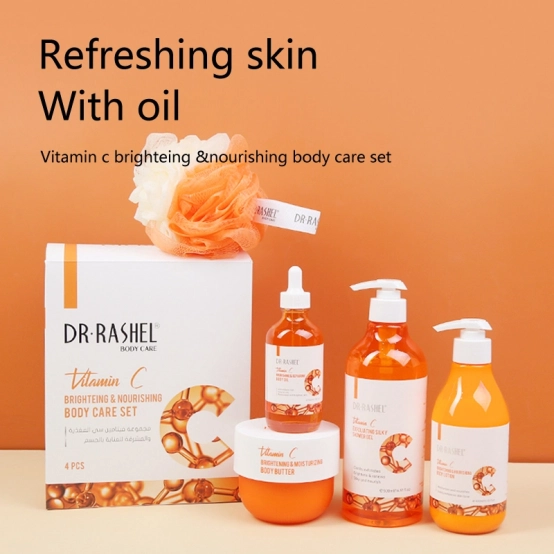
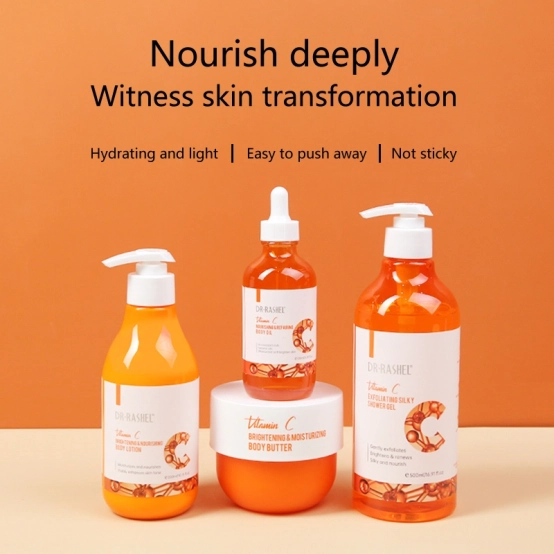
With our DRL-1689 butter, you get 250 g in a jar. The rich texture suits the sort of roughness people notice on elbows or knees. Beside it, the 300 ml vitamin C body lotion, DRL-1687, takes the lighter route. Both belong in a discussion about moisture. They don’t have to feel alike.
Imagine a customer describing two complaints. Perhaps their trousers catch against rough shins. Yet they hate having cream on their arms when they put on a sleeve. Those preferences can exist on the same body. A conversation about texture gives you somewhere useful to go; “more nourishing” on its own leaves too much unanswered.
I would be careful with “richer means better.” Better for what? A dense cream can feel comforting on a dry patch and excessive somewhere else. The customer’s objection to a heavy finish is part of the comparison, not a misunderstanding you need to correct.
Does a Thicker Vitamin C Body Butter Brighten More?
I’d ask what the person hopes to see change. Less ashiness on the legs? A stubborn dark mark? “Brighter” can mean either, and a conversation can go wrong quite quickly if you assume.
Softness Can Change the Look of Dry Skin
Take the greyish look of a dry shin. Sometimes the thing bothering someone is the flaky surface, rather than a patch of extra pigment. Once that surface is moisturized, it can look less ashy. For someone who has been avoiding bare legs, that may be the change they wanted to see.
Now picture the same comparison under a bright counter lamp. The moisturized patch looks smoother. Move an arm a little and the reflection shifts as well. It’s a useful demonstration of surface appearance, but where in that demonstration did you establish a change in pigment?
Someone asking about dry and dehydrated skin might put it quite plainly. “I want this tight feeling to go away. I just don’t want a heavy cream.” Listen to both parts of that complaint.
Uneven Pigmentation Is a Different Question
There are good reasons vitamin C appears in brightening skincare. It has antioxidant activity and can help with the appearance of uneven tone. But “vitamin C” on the front of a pack leaves several questions open. Which form? How much? Does it remain stable in that particular formula?
A fingertip can tell you about drag or slip. It can’t answer those questions about the vitamin C, however familiar the orange packaging looks.
For this butter and lotion, we can make a clear comparison of format and pack size. We cannot turn that into a ranking of brightening strength. A claim such as “the butter fades marks twice as fast” would need a direct comparison of the finished products. That is a much bigger claim than “this feels richer.”
What Do 250 g and 300 ml Actually Tell You?
Here’s an easy mistake to make on a busy day. You see 300 on the lotion and 250 on the butter, do a quick calculation and come up with “20% more.” The arithmetic works. The comparison doesn’t.
The jar is measured by mass, in grams. The bottle is measured by volume, in millilitres. To put them on the same basis you’d need to know the density. Without it, 250 g cannot simply become 250 ml on your calculator.
The figures do give you two solid facts to work with. There is 250 g of body butter in DRL-1689 and 300 ml of lotion in DRL-1687. They do not establish which pack contains more applications. A person concerned only about rough elbows will empty a jar differently from someone moisturizing both legs.
If you’re working through this with a new colleague, circle the g and the ml before reaching for a calculator. It’s surprisingly easy to overlook those tiny letters when the bigger numbers have caught your eye.
Keep the Body Butter Comparison Specific
I’d rather hear a team explain one texture difference well than recite five benefits. Someone pointing to a rough elbow has given you a useful starting point. So has the person who says every cream feels sticky beneath a sleeve. There’s no need to turn either conversation into a contest over which product is strongest.
Have a particular comparison your team keeps getting stuck on? Send us the product question and include the code, DRL-1689 or DRL-1687, so we’re discussing the same formula. “Does this feel richer than the lotion?” is a useful place to start. “Which is stronger?” needs a little more unpacking.
FAQ
With the packs side by side, these are the remaining questions worth clearing up.
Is Vitamin C Body Butter Always Water-Free?
No, although it’s easy to see why people expect that. A body butter may be an emulsion containing water. Take a look at the ingredients on the jar in question. If water or aqua is there, you’ve got your answer, however thick the cream feels.
Does Body Butter Contain More Vitamin C Than Lotion?
You would need the concentration for each formula to answer that. Neither “butter” nor “lotion” is a strength grade. The same goes for the number on the pack; 250 g tells you how much product is inside, not its vitamin C percentage.
Are the Four Products in the Set Interchangeable?
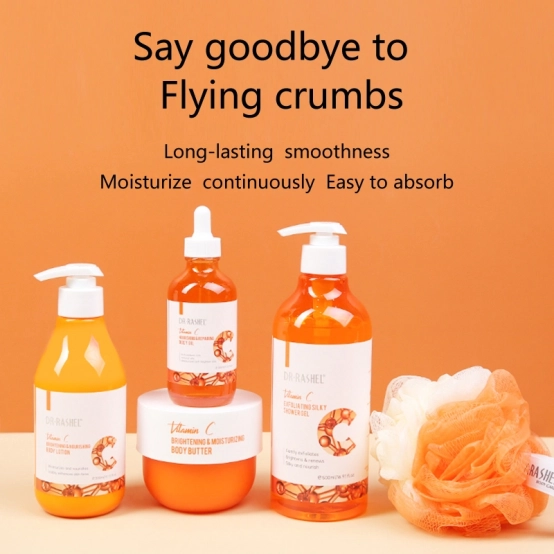
Look closely at the DRL-1741 vitamin C body care set. There’s a shower gel alongside the butter and lotion, plus a body oil in a dropper bottle. Four pieces, with different jobs. The shower gel alone makes the distinction clear; it is a cleanser that gets rinsed away.
Does a 250 g Jar Last Longer Than a 300 ml Bottle?
For whom, and over how much skin? That changes the answer. The amount used and the area covered affect how quickly either runs out. “Lasts three months” sounds reassuring, but it needs a stated usage basis to mean anything.